
Adding a Teen Driver in Missouri or Kansas: What Families Should Check
A practical checklist for Missouri and Kansas families adding a teen driver: permit timing, policy changes, liability limits, vehicle coverage, and discounts.
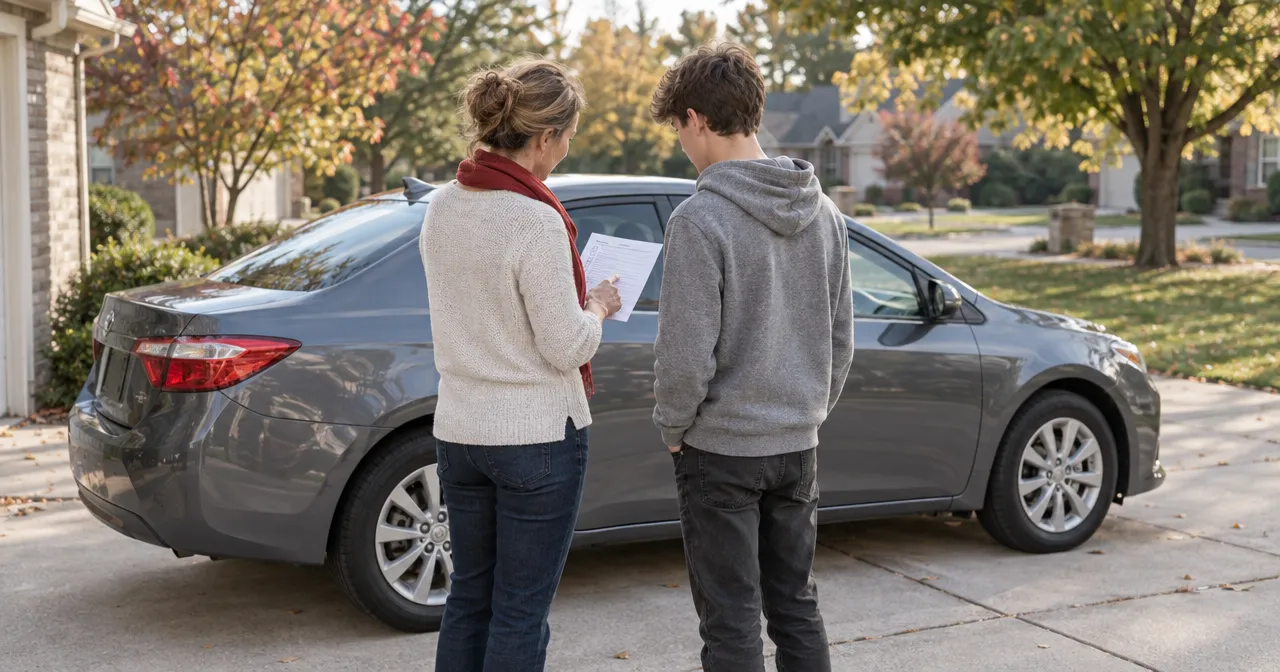
A teenager’s first drive alone changes more than the family schedule. It can change who regularly uses each car, the price of the auto policy, and the amount a household could owe after a serious crash. If you live in Blue Springs, Lee’s Summit, Grain Valley, or elsewhere around Kansas City, the right time to review insurance is before your teen begins driving—not after the next renewal notice arrives.
There is no universal rule that a learner is automatically covered until licensed, or that every teenager must buy a separate policy. Insurer rules, vehicle ownership, household residence, and the wording of your policy matter. Use the stages below to organize a specific conversation with your agent.
First, distinguish a permit from a license
Missouri and Kansas have different graduated licensing systems. Under the Missouri Department of Revenue’s graduated driver license rules, a teen can get an instruction permit at 15 and an intermediate license at 16 after meeting permit, practice, and testing requirements. Intermediate drivers face passenger restrictions and a 1 a.m.–5 a.m. restriction on driving alone, with stated exceptions. The full under-21 license is generally available at 18 after the applicable conditions are met.
The Kansas Department of Revenue’s teen licensing guide lists an instruction permit starting at 14, a restricted license route at 15, less restricted privileges at 16, and non-restricted licensure at 17 if requirements are met. The conditions differ by age and license type; for example, a Kansas restricted driver’s permitted trips, hours, and passengers are not the same as a Missouri intermediate driver’s.
Licensing eligibility does not answer the insurance question. Before the first supervised lesson, tell your insurer that your teen has or will receive a permit and ask whether they must be listed now, when a premium change begins, and which household vehicles they may practice in. Ask again before the teen begins driving alone. Record the date of your request and keep the updated declarations or written response. Do not rely on another family’s experience with a different carrier.
Tell the insurer who will drive which car
A useful call is more specific than “Please add my child.” Give the teen’s age, permit or license status, anticipated license date, address, school status, and the cars they can access. Include occasional use of a parent’s car, a second household’s vehicle, or a car a relative has let them use. Tell the insurer who owns and registers each car and where it is mainly kept overnight.
Ask these questions directly:
- When must the teen be listed as a driver? Does the answer change at the permit, restricted/intermediate, and full-license stages?
- Which vehicles and uses are covered? Can the teen drive every household car, or is a driver or vehicle excluded or restricted? Does use for a delivery job or other paid work require different coverage?
- Who should insure a newly acquired car? If the vehicle is titled to a parent, the teen, or another household member, whose policy should list it, and what are the notice and effective-date requirements?
- How will the household premium change? Ask for the revised total premium and effective date, not just a standalone quote for the teen.
Missouri’s auto insurance FAQs note that the driving records of licensed household members can affect an insurer’s decision to insure the vehicles or the household’s premium. This is one reason to disclose resident drivers accurately even if one teen usually drives only the older sedan. A driver-exclusion endorsement is not a harmless savings shortcut: ask exactly what happens if that person drives a covered car, even once.
A teen who moves between two homes needs a coordinated review. Tell each insurer where the teen lives, which cars are accessible, and how frequently they drive at each address. Do not assume the policy at one home automatically settles the question at the other. Likewise, the fact that a friend has permission to drive the family car does not guarantee every driver or use is covered; ask about the actual policy’s permission and exclusion provisions.
Start with liability limits, not the car’s value
Liability coverage addresses covered injury or property-damage claims made by other people after an accident for which the insured driver is responsible. Missouri’s motor vehicle insurance requirements state minimum liability limits of $25,000 for bodily injury to one person, $50,000 for bodily injury in one accident, and $25,000 for property damage in one accident—often written 25/50/25. Missouri also requires uninsured-motorist bodily-injury coverage of 25/50. These are legal minimums, not a recommendation that they are adequate for every family.
For a simple hypothetical, suppose a covered driver damages another vehicle and the associated property damage exceeds $25,000. A 25/50/25 policy does not turn the $25,000 property-damage limit into $50,000 simply because another number appears in the shorthand. Similarly, the $50,000 bodily-injury figure is an accident limit, while the $25,000 figure applies to any one injured person. Real claim payments depend on fault, covered damages, policy terms, and other available coverage; do not treat this example as a prediction of a settlement.
Kansas has its own required auto coverages, including liability, uninsured/underinsured-motorist protection, and personal injury protection (PIP). The Kansas Department of Insurance auto guide explains these separately. PIP can help with specified medical expenses and lost wages for occupants regardless of fault; it is not the same as increasing liability for injuries to others. In Missouri, uninsured-motorist coverage concerns bodily injury from an uninsured driver, not damage to your car. Ask your agent to compare the exact declarations and state requirements for the vehicle’s registration and garaging location.
Consider what your family would want available if a crash involved multiple people or expensive property. Ask for quotes at more than one liability limit and compare the whole-policy difference. If you already carry a personal umbrella, check its required underlying auto limits and whether the teen and relevant vehicles meet the umbrella’s conditions. Merely adding the teen to an auto policy does not prove an umbrella now applies to every vehicle or driver.
Decide separately how to protect the car
The value of the car and your ability to replace it are different questions from liability to others. Collision generally addresses damage to your insured car from a collision or rollover; comprehensive generally addresses covered non-collision losses such as theft, hail, or a falling tree. The Kansas insurance department’s auto guide distinguishes these coverages and notes that a lender or lessor may require them even though they are not universally required by law.
If your teen will use an older, paid-off car, compare the added premium and deductible against the car’s current value and the amount you could absorb after a loss. If the car is financed, confirm the lender’s requirements before changing physical-damage coverage. A deductible applies to qualifying claims under the policy; raising it can reduce a premium but increases what you pay for a covered loss. Check rental reimbursement and roadside assistance separately if a car being out of service would disrupt school or work. Do not assume collision, comprehensive, rental coverage, or a loan balance shortfall is included just because a vehicle appears on the declarations.
A storm-damaged car in a school parking lot is a useful test case: ask whether the vehicle has comprehensive, what deductible applies, and how the claim would be handled. A parking-lot crash with another car calls for a different analysis. Keeping the situations separate makes a quote easier to compare.
Compare a family policy with a separate policy using the same facts
Putting a resident teen on an existing family policy is often a starting point, but the right structure depends on how the car is titled, who lives in the household, insurer eligibility, and the contract. If a teen buys and titles a car in their own name, ask whether the family policy can insure that interest or whether a separate policy is needed. Do not buy a low-priced separate policy without checking who is actually named, which car is insured, and what happens when the teen borrows a household vehicle.
Request comparable proposals with the same liability limits, uninsured/underinsured-motorist selections, physical-damage options, deductibles, and eligible drivers. Otherwise, a lower price may simply reflect less protection. Check multi-vehicle or home-and-auto discounts, good-student eligibility, driver-training discounts, and any driving-behavior program available from the quoted carrier. Discount criteria and availability vary; ask what documentation is needed and whether a program collects driving data before enrolling. Greco Insurance Agency can compare suitable options through Farmers Insurance and partner carriers, rather than assuming one discount or policy setup fits every family.
Update the policy when school, work, or residence changes
The first license is not the last trigger for a policy review. Tell the insurer if your teen becomes the primary driver of a different car, buys one, moves out, goes to college with a car, leaves a car at home, or begins using a vehicle for work. Where a car is regularly garaged and how it is used can affect rating or eligibility. Ask whether a student-away arrangement or other carrier-specific option applies; do not remove a student from coverage simply because classes are out of town.
A part-time delivery job deserves particular attention. A personal auto policy may restrict certain paid driving, while an employer’s insurance may not cover every vehicle or situation. A business owner whose child drives a company vehicle should ask about the commercial auto driver list and permitted use rather than assuming the family auto policy applies. The same principle holds if a contractor’s pickup is regularly used for business work: disclose the actual use and confirm the right policy.
Keep household policies in view, too. An auto liability review is a sensible time to revisit a home or renters liability limit and any personal umbrella requirements, but those policies do different jobs. Homeowners insurance does not repair the teen’s car after a collision. Life insurance can help address lost family income after a death; it is not a substitute for adequate auto liability. Reviewing them together helps identify gaps without treating them as interchangeable.
Pair the coverage review with a driving plan
Insurance pays or defends only as the policy provides; it does not prevent a crash. The National Highway Traffic Safety Administration’s teen-driving guidance urges families to set rules about passengers, nighttime driving, distraction, seat belts, and impairment, and to practice regularly with novice drivers. Missouri and Kansas licensing limits are the floor; a household can choose stricter rules while the teen gains experience.
Before the first solo drive, show your teen where the insurance card is, how to contact you, and what to do safely after a collision: check for injuries, call emergency services when needed, exchange information, document the scene if safe, and report the incident to the insurer promptly under the policy’s instructions. Keep the conversation practical rather than assuming a new driver will remember every step under stress.
A short pre-license checklist
- Confirm the teen’s current license stage and the applicable Missouri or Kansas driving restrictions.
- Notify the insurer of the permit and expected solo-driving date; ask when the teen must be listed and keep written confirmation.
- Verify each car’s owner, primary driver, garaging address, covered use, and any excluded driver.
- Compare liability, uninsured/underinsured-motorist, and applicable medical/PIP coverages; check umbrella requirements if you have one.
- Decide on collision, comprehensive, deductibles, and optional transport coverage car by car.
- Request the revised household price with documented discounts and the effective date of each change.
- Revisit the setup after a new car, new job, move, college departure, or change in who drives most often.
The central question is not simply “How much will adding my teen cost?” It is which drivers and cars are covered for which situations, at what limits, starting when. For a personalized review with a local agent serving Missouri and Kansas families, request an auto coverage review from Greco Insurance Agency. The team can explain the current policy, flag questions to resolve, and help compare suitable options before your new driver heads out alone.